The TRUTH about coating!!

Dr_Pain

Certified Finest Installer
The following quote was taken from another forum I participate in and for some reason it got me fired up. I've replied to the thread with the following and I thought it would be important to share with my CarPro family as well. Enjoy!!


Ceramic Pro 9H claims Permanent if you bring it in for the annual check-up

5 years if you don't

Reading the specifics of the warranty are interesting, what it does and does not cover

Most importantly, any damage to the coating must be reported within 30 days

I normally try and stay out of those types discussions because there are too many variables associated with the longevity of coatings HOWEVER I would like to offer a tid bit of my chemistry background to the conversation.

Without making this conversion too technical (so please assume that in order to simplify my answer that some technicality have been ignored), I will offer that in the world of chemistry that 2 main basic bond exists:

1) Ionic (weak covalent, if you want to be technical)
2) Covalent

A chemical bond is defined as: a mutual attraction between two atoms resulting from a redistribution of their outer electrons.

An ionic bond is formed when one atom accepts or donates one or more of its valence electrons to another atom. That makes them electrostatically attracted together. This bond can be easily broken by any other atoms which have greater electronegativity. A covalent bond on the other hand is formed when atoms share valence electrons, which makes this bond much harder to break, and barring exposure to those elements of disruption, this bond is stable and considered "permanent".

The coating technology I know most about is the Quartz technology (since I am a Finest installer, and researched this technology more extensively). Although other coating technology exist (resin based etc..) the basic chemistry still applies although they may differ little in their chemical reactions. In the CQuartz technology, the Si (silicon) in suspension gets delivered to the paint (or other substrate) where its carrier agents (solution) is allowed to evaporate. As it evaporates the Si atoms will try and find chemical stability and will readily pair with O (oxygen) to create the stable covalent molecule of SiO2 (aka. silicon dioxide). This nano-size molecule bonds to other molecule to form a matrix, which fills all those little imperfections in the paint, creating a layer thickness of 1-3 micron in thickness. So far because we are talking about a covalent chemical bond I am in complete sync with all those companies that claim "permanency". Barring any mechanical or chemical disruption of the matrix, you will have a substance that will technically last FOREVER.

Here is a advertising picture I created to promote my business, and CQuartz Finest which may give you a visual of what I am talking about.

10499486_746096158786094_7066830013593314262_o.jpg


Where my brain do find objection in those marketing "shenanigans" of using the word PERMANENT stems in the fact that the bond that the matrix forms with the clear coat is an IONIC bond. There are no reagents in the clear coat (which is a stable matrix on its own) that will react to create a COVALENT bond with the nano-ceramic matrix. So please do yourself a favor and stop believing the hype. The only reason the CQuartz coating matrix stays in place is because you have a mechanical interlocking of the 2 structures, and a WEAK ionic bond (attraction) between the two matrix. AND this is REGARDLESS if you bring it in for regular checkups!!:nomore:

Clear coats are applied to base coat paint in the same way. They do NOT make a covalent bond and that is a reason why manufacturers don't put a "Permenant" label on their clear coats. Have you ever seen clear coat failure and complete delamination of the clear coat from the base coat?

delamination3.jpg


Now in a perfect environment with no harsh UV rays, acid rain, exposure to industrial spraying, solvents, or contact with non-pH neutral solutions etc... than EVERY coating is permanent. But have you ever tested the pH of road grime, which we all get on vehicles!?!? Do you even know what that road grime is?? Simple answer, in most part it is a mix of engine, transmission, gear oil and other petroleum based products, mixed with contaminated soil and run off water from Lord knows where containing Lord knows what. In other words, definitely not a pH neutral mixture, but more a mixture of earth products and petroleum SOLVENTS!

Next time you are riding in the sunset with your honey and see this darkened area of pavement in the center of your lane remember that it is this road grime mixture I've spoke of and be afraid, be very afraid!!!

o-ROAD-TRIP-facebook.jpg
 
Last edited:
Thank you Claude. By chance was that a thread started by someone with the letters b----h----?
 
LOL, how did you know!!


Oh, I had a familiar feeling. When I use to be on another company's brand specific forum, he would be fine for the most part. When his statements are challenged, that is when it gets interesting. He will make a post but when he is questioned or asked to further elaborate he will become apathetic or accusatory, in that those asking for such become "hostile or are attacking..." If you are going to make a statement and sound authoritative, be ready to stand behind them with facts or with references. Funny that he doesn't view some of his posts as what could be construed as, shall I say, adversarial?
Ah, it's the Christmas, Hanukkah, Boxing Day, Kwanzaa, Festivus, and whatever one celebrates season so I'm not going to dwell on the negative...LOL!
Your post is very educational Professor Claude!
 
I've been following that thread also . Least ,I'm pretty sure it is the one you are referring to , specially when op said the initials ...
 
Oh, I had a familiar feeling. When I use to be on another company's brand specific forum, he would be fine for the most part. When his statements are challenged, that is when it gets interesting. He will make a post but when he is questioned or asked to further elaborate he will become apathetic or accusatory, in that those asking for such become "hostile or are attacking..." If you are going to make a statement and sound authoritative, be ready to stand behind them with facts or with references. Funny that he doesn't view some of his posts as what could be construed as, shall I say, adversarial?
Ah, it's the Christmas, Hanukkah, Boxing Day, Kwanzaa, Festivus, and whatever one celebrates season so I'm not going to dwell on the negative...LOL!
Your post is very educational Professor Claude!

I've seen a lot of post by this particular fellow and he DOES sound very assured and authoritative in his remarks. It is just in this thread he started that I realized that he is an "enthusiast" or as he refers to himself as a "hobbyist". I am not sure that it is his remarks that set me off (because I did not read the whole thread) or the title of the thread but I know that the "permanent" remark always resonate strongly (and negatively) in my head. We shall see what comes of it ;)
 
LOL...Yes we shall see. I also did see that another trouble maker, Rasky, chimed in...J/K. BTW, in this day of Political Correctness, I do not see you as a trouble maker. Well, most of the time...:-)
 
LOL...Yes we shall see. I also did see that another trouble maker, Rasky, chimed in...J/K. BTW, in this day of Political Correctness, I do not see you as a trouble maker. Well, most of the time...:-)

Did you see that I evoked the response of a certain person with a more impressive curriculum vitae!?! It is about to get interesting ;)
 
Oh my! I'm going to need a PhD sitting next to me...oh wait, you are already here!

BTW, I appreciate the simplification.

Round 3, DING DING DING
 
Just a note the 2 Mohs hardness described by CQuartz is an INCREASE of 2 Mohs above the existing paint hardness
 
Just a note the 2 Mohs hardness described by CQuartz is an INCREASE of 2 Mohs above the existing paint hardness

Hey Corey, when you get a chance to send me the technical comparison of all CQuartz, you think we could have a chat on what testing was done and why CarPro chose a 2 Mohs increase to describe the hardness over just discussing the scratch resistance/hardness of the coating alone. Should not take to long but may help me in creating the comparative charts and for the detail posting on the forum. Does the underlying clear actually impart hardness/scratch resistance to the coating?? considering that it is the same technology??
 
Uh oh...Lock and Load! Just remember Claude, it is the Holiday Season...LOL!

Steve
 
Interesting.

I would assume one of the most difficult aspects of getting coatings like CQuartz to properly bond is squeaky clean paint. And that I imagine can be a process fraught with frustration at times.

Is CP Eraser adequate? I believe in some instances yes, and maybe in some instances no. I wouldn't expect a one time rub of Eraser to remove 4 years of Collinite #476 in one go.

The ability to properly prep paint beforehand may make or break the Coating process. Me, I maybe got lucky I guess. CQ UK went onto my '97 Tahoe like a dream. And it's holding up just like I hoped, just like the day I applied it.

Polishing processes had probably rid the paint of 15 years of 3 dozen other products used.

And next spring, when the weather's nice, and I have the right mood, heck, I'm gonna apply another coat of UK on the paint!

I'll just have to cut through a couple applications of Reload is all.

I conclude, I cannot change the world, they'll choose whatever they like, but for me, I've been around the block a few times, and realize this was the best product I ever slathered onto that paint. And I figure it's a paint that cannot take too much more in the way of polishing, rubbing, and aggravating that delicate and old paint.

That paint looks superb! And I suspect carpro products will keep it that way another 15 years if I choose.
 
Last edited:
Prep is 95% of the battle. I think that folks look at the application of a coating the same as wax, not everyone just to clarify. Whenever I apply a coating, which is a whoppjng 4 x's, I go the whole gamit of deconing, polishing, cleaning (Eraser or IPA wipe) then the coating.

Like you Mark, my application of CQUK was easy. With that said my friend helped me, the atmospheric conditions were perfect, and I had plenty of Pro help from here. If you and I are happy then we are ahead of the game.

Everyone is different and to each their own. I like the coatings but I also know I have a responsibility to care for it properly in order to get the longevity out of it.

BTW, I use to own the two door version of your vehicle with black fender flares. It was actually the GMC Yukon. My buddy, who was an Art Major, painted a bug shield for me. It said YUKON CORNELIUS and it had the Rudolph character on the side. Many a person got a kick out of it.

Steve
 
Sorry if my post does not continue in the line of what you guys were talking about but I was challenged in a rebuttal which may be interesting to you guys as well. I am posting it here to be able at some point in the future to have an exposee on the subject. Currently, I don't have enough information, so for now just enjoy the read

Since what evoked my response was Allen's post about 9H, let me take their own descriptor to further reinforce my point about "permanent". How can you claim permanence and have a marketing descriptor such as "RESISTANT"?? (This is a quote from 9H)
-Scratch Resistance (Above 9H)
-Weather & UV Resistance
-UV & Temperature resistant
-Thermal Resistance (up to 750°C)
-9H can only be removed by abrasion​

Doesn't the above indicate that it is susceptible to mechanical, and thermal disruption? Therefore not Permanent?

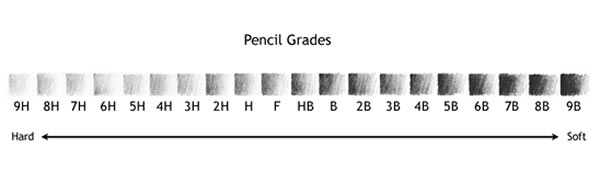
Just to stay with 9H subject for a second, even their independent testing by SGS is misleading. The standardized scale of hardness is called the Mohs scale of mineral hardness (developed by Friedrick Mohs). The testing done by SGS (the independent firm that did the testing for 9H) does NOT reference a scratch test using standardized measures, but uses a testing process they invented using pencils of varied degrees of hardness from 6B to 9H (remember those No2 pencils we had to buy in school)

peng.jpg


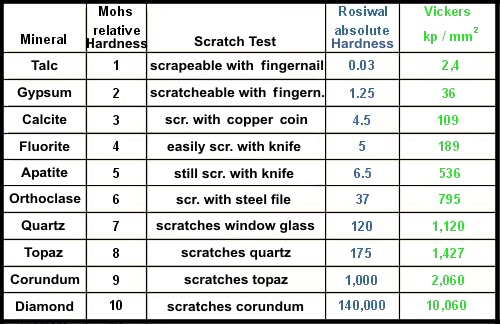
A true "scratch test" will use varied testing minerals to compare their hardness (from talc to corundum) where the H is actually a measure comparative to known standards (10H being diamond).
Did anyone ever figure that 9H references a lead pencil, rather than the true scale of mineral hardness?? Don't tell me this is not misleading, especially when you have other companies that actually had independent scientific studies using standardized an accepted scales.

Quick Edit: This is a search I did to see how a lead pencil would stack up on the MOHS scale: On the Mohs scale, graphite (a principal constituent of pencil "lead") has a hardness of 1.5; a fingernail, 2.2–2.5; a copper penny, 3.2–3.5; a pocketknife 5.1; a knife blade, 5.5; window glass plate, 5.5; and a steel nail, 5.5. A streak plate (unglazed porcelain) has a hardness of 7.0. (This is not my research and is not verified but seems about right, from what I know)

mohs%20en.jpg
 
And lastly..... and for some reason the 12 page thread came to a grinding halt?!?

Ha ha, pencil scale, good one. Wait...that's not a joke, that's their marketing mumbo jumbo? Well, apparently they didn't invent it: The Pencil Hardness Test . And it may be some sort of valid comparison test, but clearly bogus if they are suggesting it has a Mohs hardness of 9H...but I can't find anywhere where they actually suggest that.

I believe the actual test performed by SGS was their own invention as I could not find any other references of this test for any other substrate, nor could I find true MOHs hardness testing on the 6B to 9H pencils. The process does seem scientific enough (with the little gadget they put together to keep the load on the pencil tip) but I would give them a hard time if I was presented me with this "Independent Study", unless it had enough data point to pass statistical standards of Double Control Testing. But then again I would want a measure that could pass the scrutiny of the scientific community also, and in terms of hardness scale the MOHS scale IS the standard. Here is a link to the study by SGS on behalf of 9H
http://ceramic-pro.de/wp-content/up...S-HV905689X.Hardness-by-Pencil-Test-1000g.pdf

As for your other question, that is the beauty of deception in MARKETING!! They did not explicitly state their "H" was on the Mohs Scale but did not divulge that it was pencil hardness either. Someone looking to compare the 2H (MOHS) claim by CQuartz and a 9H by Ceramic Pro would never think that 9H referred to pencil graphite, especially when you are researching scratch resistance and coating hardness. They capitalize on the fact that most detailers (or car owner) don't know Adam from Eve, but they know that they will Google "scratch resistance scale" in comparing (if they don't buy 100% in their marketing literature about how good their product is), and the first result is the MOHS scale!!

Now if we could get ALL manufacturer to adopt the same independent testing, and that independent testing could pass scientific scrutiny, and that all results were presented in the same format.... well heck, that is NEVER going to happen!
 
Interesting.

I would assume one of the most difficult aspects of getting coatings like CQuartz to properly bond is squeaky clean paint. And that I imagine can be a process fraught with frustration at times.

Is CP Eraser adequate? I believe in some instances yes, and maybe in some instances no. I wouldn't expect a one time rub of Eraser to remove 4 years of Collinite #476 in one go.

The ability to properly prep paint beforehand may make or break the Coating process. Me, I maybe got lucky I guess. CQ UK went onto my '97 Tahoe like a dream. And it's holding up just like I hoped, just like the day I applied it.

Polishing processes had probably rid the paint of 15 years of 3 dozen other products used.

And next spring, when the weather's nice, and I have the right mood, heck, I'm gonna apply another coat of UK on the paint!

I'll just have to cut through a couple applications of Reload is all.

I conclude, I cannot change the world, they'll choose whatever they like, but for me, I've been around the block a few times, and realize this was the best product I ever slathered onto that paint. And I figure it's a paint that cannot take too much more in the way of polishing, rubbing, and aggravating that delicate and old paint.

That paint looks superb! And I suspect carpro products will keep it that way another 15 years if I choose.

Great to hear Mark! Exactly right about Eraser. I have screamed from the rooftops o this point that you MUST polish if you care about your work and are going to coat. Avi of CarPro taught me this when I first started using their products. And it made perfect sense instantly!

#1 - Eraser is not made to remove sealants or durable fillers but to remove oils.

#2 - Even if you were to remove a sealant completely 100%x2 how do you know you don't have any oxidation? Its not so easy to see light oxidation on a clear coat. In fact I would submit that you most certainly have oxidation on the car if you don't polish first! And :) Coatings don't want to bond to that crud! :):):) Sorry, got excited at your point and the fact some people do NOT polish first with some manufacturers not even pushing them to do so and got me going :)
 
Last edited:
And lastly..... and for some reason the 12 page thread came to a grinding halt?!?

Funny, I did notice that too. Is it because folks are becoming weary of the topic or that something has been brought forth that is too technical for most folks? Could it be something more?
I applaud you Claude for your efforts. It elevates our knowledge in what to look for and to be better informed.

Steve
 
Well well well Claude, I see someone came out of hiding to respond to your posts. Too bad he didn't respond to "it's not a price increase" but then his rep tells pro's how to sell the price increase to customers.
 
Last edited:
Back
Top